
"Nobody Knows How to Manage This." I Can't Say That Anymore
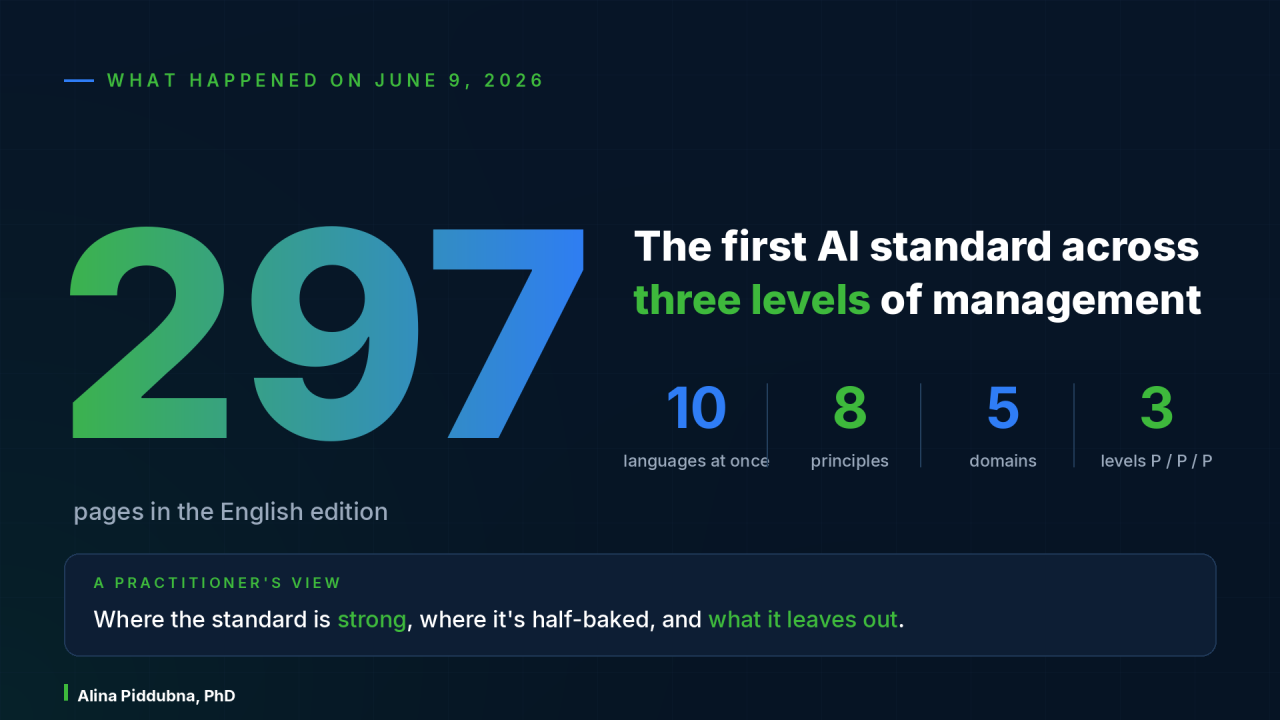
Article by Alina Piddubna. A year ago a mentee asked me how to manage an AI program, and the only honest answer was "nobody knows." Now PMI has published its first standard on AI in portfolio, program and project management: 297 pages, 8 principles, 5 domains. I read all of it as a practitioner. Here is what's strong, what's half-baked, and what I would apply first.
By Alina Piddubna, PhD, PMI-CPMAI, PgMP, PfMP, AWS AA
About a year ago, a young business analyst came to me for mentoring. His company had just asked him to lead a program of AI initiatives, and he was honest with me in a way people rarely are: “Alina, I’m afraid to make a mistake. I know how to work with requirements. I can build a business case. But I don’t know how to manage a program like this.”
I gave him the only honest answer available at the time: “Nobody knows. And if someone tells you there’s a guru with the exact recipe, that person is most likely selling something. So let’s figure out together what right looks like for your company.”
I’ll tell you where that young man is today at the end of this article. Remind me if I forget.
The reason I’m telling this story now: the answer “nobody knows” has an expiry date. This year PMI released the first standard in its history dedicated to using AI in portfolio, program, and project management. On July 1st I held a webinar for the PMI Ukraine Chapter where I walked through the document page by page, from a practitioner’s seat. The recording is here, with one fair warning: it’s in Ukrainian. If that doesn’t stop you, welcome.
For everyone else, here is what I found, what I’d take into work tomorrow morning, and where I’d keep my own judgment switched on.
What we’re dealing with
The facts first. 297 pages in the English edition. (The French version runs 342. Same standard, 45 extra pages. French always needs more words, and as someone living in France, I confirm this applies to everything, lol.) Released simultaneously in ten languages. Eight principles, from strategic value and data as the foundation of probabilistic systems, through risk, governance, people and culture, ethics, and stakeholder alignment, to a principle with the wonderful name “optimization and innovation,” which is really about fighting algorithmic decay. Five performance domains: strategy and value, stakeholders, delivery lifecycle and tailoring, risk, and a genuinely technical one, architecture and data quality. Coverage across all three levels: portfolio, program, project. Notice one quiet revolution in that list: data quality sits at the level of a principle, not buried in a technical appendix. The standard treats it as a decision-making criterion, and it’s right to. It took roughly two years, a core team of fifteen, a separate group of reviewers, and two rounds of public comments that gathered about a thousand remarks from some three hundred people worldwide.
One detail I love about how it was made: the working group deliberately mixed two kinds of people. Experts who had implemented AI but didn’t know project management, and project management experts who didn’t know AI. Two worlds sat down at one table and negotiated a document. Which is exactly the collision happening inside every organization right now, and the standard carries the fingerprints of it.
And it is technology-agnostic. You will not find ChatGPT, Claude, or any foundation model named anywhere in it. That was a survival decision. When model generations change every few months, the only way to write something that isn’t obsolete by spring is to write about principles, not products. It worked. I’d give the document a solid three years of relevance, which in this field is close to immortality.
Why does such a standard need to exist at all? Two numbers from my slides explain it better than any argument. BCG found in 2024 that 74% of companies struggle to achieve and scale value from AI. McKinsey’s “Superagency in the Workplace” research puts it even more bluntly: only 1% of leaders describe their companies as mature in AI deployment. Everyone is investing, almost nobody is capturing. AI adoption without a framework looks the same in every organization I visit: fragmented pilots, and risks nobody owns. That gap between spend and benefit is the problem this document was written for.
The thing that actually changed Here’s the shift I keep explaining to executive teams, and the real reason a PMBOK alone is no longer enough.
For our entire professional history, managers delivered deterministic results. Predictive or agile, waterfall or sprints, the deliverable was defined, built, handed over, and it stayed what it was. That era is ending. An AI system keeps changing after you hand it over. Feed it new data and the output shifts. Feed it the same data twice and you may get two different answers. It drifts over time.
You are no longer delivering a product. You are, in a sense, raising a child. It changes as it grows, one day it can become independent of you, and the question of what kind of “person” it becomes is now a management responsibility. That requires a different paradigm: not “plan, execute, close,” but continuous stewardship of a probabilistic system.
Which brings me to the most revealing pattern in the whole document.
Have you ever had to justify being human?
The standard repeats, on nearly every page, in every domain, at every lifecycle stage: the human decides. The human verifies. The human stays in the loop. Data selection, model training, pilot launch, integration, reporting: human control, human control.
Think about how strange that is. No previous PMI publication ever needed to state that decisions are made by people. It was like specifying that a car comes with a steering wheel. And there’s a rule I trust from psychology: when someone talks about something constantly, it’s because it hurts. The insistence on human-in-the-loop tells you what the authors are genuinely worried about: systems generating decisions and data with consequences nobody is watching. And this caution doesn’t come only from the project management side. While reading the standard I kept hearing Dario Amodei in my head, the CEO of Anthropic, one of the people building this technology, who keeps repeating essentially the same thing: be careful, and prepare. When both the builders and the managers of AI converge on the same worry independently, that’s not paranoia. That’s the honest state of the technology.
For directors and VPs, this repetition quietly tells you where your governance budget should go.
What I would apply in practice
Start with a shared lexicon. The standard itself opens with this recommendation, and its glossary is a decent seed. When your CFO, your engineers, your vendor, and your board each mean something different by “model,” “agent,” and “bias,” every steering meeting costs you double.
Then, before you scope any transformation, run a readiness assessment. It will show you where your real gaps are, and in my experience the gaps are almost always data and skills. If your organizational knowledge lives in people’s heads and nowhere else, you have nothing to train an agent on, and no reorganization will fix that. Every stalled AI adoption I’ve seen traces back to a gap that an honest two-week assessment would have found. This is where we start every transformation conversation at Intellias, and I was glad to see the standard institutionalize the habit.
Also, steal the risk catalog. This may be the most immediately useful part of the document. Alongside classic project risks, it names the new species: hallucinations, overreliance (major firms have already paid six-figure penalties for unverified AI-generated content in client reports), data poisoning, model drift, the black-box dilemma, and my personal favorite, Shadow AI. That’s when your employees, unimpressed by the corporate tool, quietly use their personal free chatbot accounts for work, client data included. Free tiers train on your inputs. Somewhere on the other side of the world, your client’s numbers surface in someone’s recommendation. If Shadow AI isn’t in your risk register yet, add it today.
And one small gem from the stakeholder guidance: learn to tell a skeptic from a critic. A skeptic resists AI but cannot say why. Noise. A critic resists with arguments, and a critic may be seeing a risk you missed, so take that person by the hand, sit down, and listen carefully. When I announced this webinar I called myself a skeptic of the standard. Then I thought about it and corrected myself: no, I’m a critic. Everything below is offered in that spirit.
Governance has a heartbeat now
The longest principle in the document is not ethics, as most of my webinar audience guessed. It’s governance and compliance. And the treatment is genuinely modern: governance here is iterative, not installed once and forgotten.
In practice that means observability. Your KPIs must adapt to how the model actually behaves in production. Risk thresholds get revisited as behavior drifts. Funding decisions become a rhythm, not an annual event. This is where that “algorithmic decay” principle earns its keep: a model you don’t watch is a model that is quietly getting worse. And because deep systems don’t explain themselves, you build explainability and transparency in deliberately, so that when the model makes a call, you can see why.
One structural note the standard makes that I want to underline for executives: build one governance body for AI across the organization, not a committee per project. Otherwise your people will do nothing but sit in sessions.
And a technical nuance that will save you real friction with your engineering teams. The standard presents bias mainly as unfairness, which is true at the human level. But bias is also a technical term, measured by a couple dozen metrics, tuned through calibration, traded off against accuracy and cost. If you file it under “just be fair” and stop there, you won’t understand what your technical people are asking for when they say a model needs recalibration. I work hands-on with cloud AI stacks, and I promise you: the border between managerial and technical competence is dissolving from both sides. The standard gets you to the border. Crossing it is your own homework.
Where to keep your own judgment on
A few things, said with warmth, because this is a first edition and first editions are supposed to be imperfect.
The standard describes an idealistic world. The working group used foresight deliberately, writing toward where the field is going rather than where it is, and that’s a legitimate choice for longevity. Just don’t read it and develop an inferiority complex because your company doesn’t look like that yet. Nobody’s does. Independent research keeps confirming that most enterprise AI is still at the experiment stage, and many published ROI cases are stretched rather thin. Treat the standard as a compass, not a mirror.
Then there’s a gap that matters enormously if you operate in Europe. The document lists relevant legislation in an appendix, and the EU AI Act is not on that list. Nothing in the standard contradicts European law. It simply doesn’t mention it. So keep your own regulatory map open next to it. For anyone serving European clients, that map is not optional.
And the standard is silent on competencies, meaning what skills the people who implement and govern AI actually need. It also reads through two lenses at once, sometimes mid-chapter. One lens is AI as a tool for project managers. The other is AI implementation as a program to be managed. Once you know the two lenses are there, the reading gets much easier. I expect all of this to improve in the next revision, and the working group itself is refreshingly honest that some sections were finished under deadline pressure.
None of this cancels the document. A map with a few blank regions is still a map, and a year ago we were navigating by the stars.
The ending I promised
That young business analyst who was afraid to make a mistake? He now leads the AI enablement unit in his organization. Not because a standard appeared. Because he moved before one existed, thought about value instead of hype, and started small: quick wins, small initiatives, visible benefit, then scale. Which, funnily enough, is exactly what the standard now recommends.
The managers who will do well in the next few years are not the ones with the best tool subscriptions. They are the orchestrators of hybrid teams, where the roster includes people and agents side by side. I closed my webinar with a definition I’ll repeat here, because I believe it more with every project: to direct the machine well, to critically evaluate what it produces, and to turn it into value that survives three audits, compliance, ethics, and business value. That is a manager now.
So here is my question to you, and I mean it as a working question, not a rhetorical one: somewhere in your organization today, a model output is flowing into a decision without a human seriously looking at it. Do you know where?
If you can name the spot, that’s your first quick win. If you can’t, that’s your first assessment.
Articles worth reading without the inbox clutter
InStar publishes practitioner analysis on management, AI adoption, and organizational delivery. Get new content when it's ready in your mailbox.
No spam. Unsubscribe at any time.